
It is a cold winter afternoon in Montparnasse. We change tables twice, looking for a warmer corner, and the small gesture stays with me throughout our exchange. In Kremenchuk, in Dnipro, in Kharkiv, there is no warmer corner. There are apartments without heating, hospitals running on generators, entire neighbourhoods where winter is not a season but a threat to survival. Svitlana Usychenko does not make the comparison herself. She does not need to. An urban planner and spatial researcher based between Paris and Kyiv, she has spent the past four years with Ro3kvit Urban Coalition for Ukraine and the NGO ReThink, helping cities prepare not only for the next strike but for the next decision: the masterplan drafted under pressure, the funding that arrives with conditions attached, the demolition approved before anyone asks what stood there and why it mattered. Over coffee, she lays out her subject with a precision that leaves little room for comfort. Reconstruction, she explains, is never just repair. It is a redistribution of power. And the most consequential choices are the ones made when no one is paying attention.
Urgency Is Not Neutral
From the very start of our conversation, Svitlana dismantles the vocabulary that dominates reconstruction debates. Speed. Efficiency. Modernization. These words, she argues, sound technical but carry political weight. A city rebuilt quickly is not automatically a city rebuilt well, and the pressure to act fast tends to favor those who are already powerful: investors with ready capital, institutions with ready models, donors with ready agendas. What gets sacrificed in the rush is rarely visible at first. It appears years later, in privatized riverbanks, in demolished neighborhoods that nobody mourned officially, in public spaces that quietly ceased to be public.
Her conviction did not come from theory. It came from Sarajevo. During her master’s studies at Politecnico di Milano, Svitlana devoted one of her final research studios to the reconstruction of the Bosnian capital after the 1992 to 1995 war. At the time, the full-scale invasion of her own country had just begun, and Ukrainian professionals were urgently scanning history for lessons. Sarajevo was the most recent European case of a city destroyed and rebuilt. What she found there unsettled her. Reconstruction had indeed been fast, at least in places. But it had unfolded under heavy influence from outside actors, with funding tied to political agendas and little participatory process. Foreign donors financed prestige buildings without thinking about the urban fabric around them. And the timing was cruel: the city was rebuilt during the triumphant years of globalized architecture, when every skyline demanded a shopping mall.
“Shopping malls appeared in places that used to be important for communities, cultural spaces, memory spaces,” she recalls. “Speed was prioritized, but not social meaning, not memory, not coherence.”
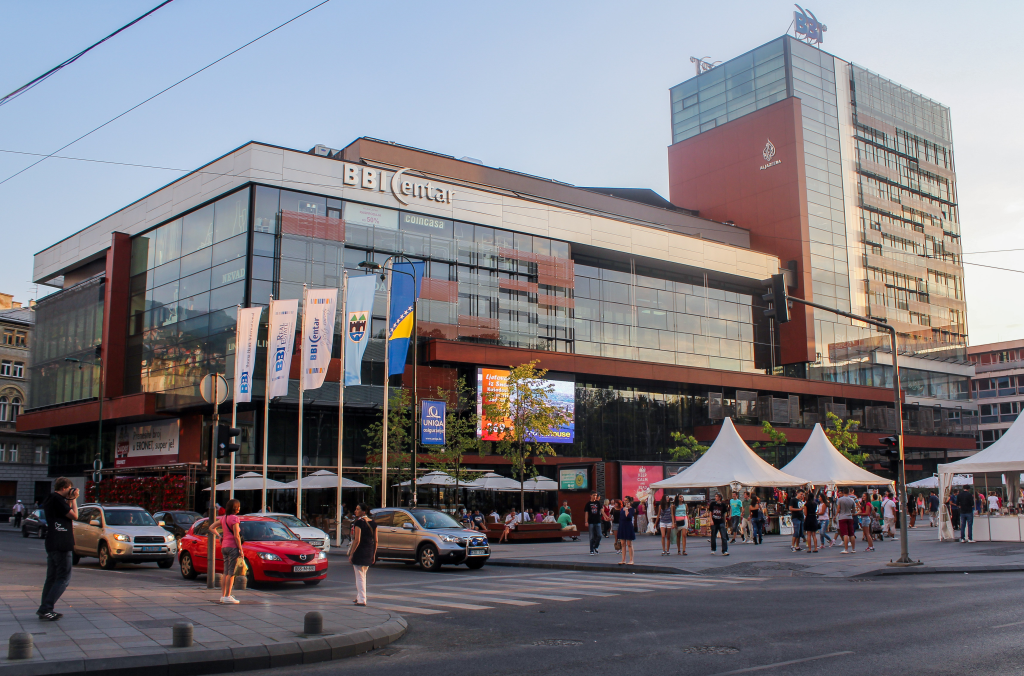
Decades later, many areas of Sarajevo remain unreconstructed, while the malls still stand. For Svitlana, this is not a Balkan anecdote. It is a preview of what Ukraine could become if it rebuilds in a hurry, with imported models and without asking who decides.
A Revolt Born on the Left Bank
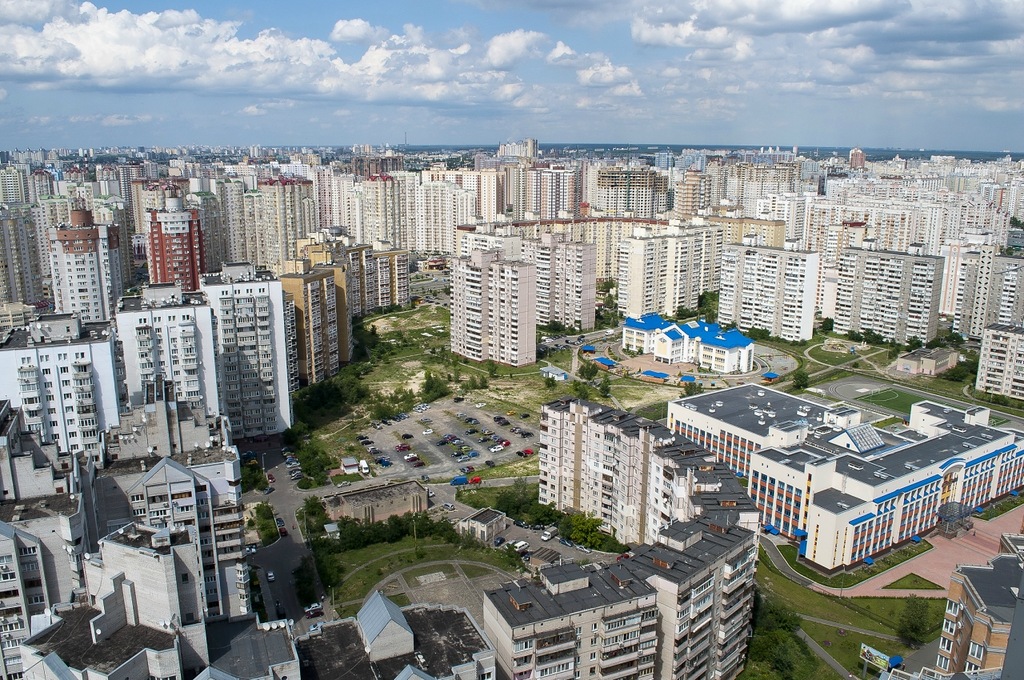
To understand why these questions matter so personally to her, one has to go back to where she grew up. Svitlana was born in Kyiv and raised on the Left Bank, the sprawling eastern side of the city, where former villages were absorbed into high-rise residential districts, a mix of Soviet and modern, developed with more haste than care. She does not romanticize it. The environment was chaotic, poorly planned, indifferent to the people living in it. Architecture, for her, was never a childhood dream of beautiful buildings. It began as a quiet revolt against an environment she had not chosen.
“I remember thinking very clearly: cities could be much better, much more humane, much more coherent,” she says. The conviction that the spaces we inhabit shape how we feel, how we behave, how we relate to each other, took root early.
There was also a generational ingredient. She came of age during Ukraine’s years of accelerated digitalization, the era of the “state in a smartphone,” when public services were being reinvented at startup speed. If digital institutions could be transformed so quickly, she reasoned, why not cities? Why not urbanism, a field that seemed frozen in Ukraine? Looking back, she admits the thought was naive. But it was a productive naivety, an optimism about the possibility of change that still fuels her work.
Her studies followed that intuition. A bachelor’s degree in architecture in Kyiv, where sustainability was barely mentioned in the curriculum, so she taught herself: life-cycle assessment, energy-positive buildings, methodologies she found outside the university walls. Then the realization that everything she was painstakingly discovering on her own was already standard elsewhere. So she left for Milan, where Politecnico had long integrated these approaches into how architecture was taught. Before that, a formative year at the Center for Spatial Technologies in Kyiv had shown her something that would prove decisive: that research is not an academic ornament but a tool that shapes real decisions.
In Italy, one case marked her more than the others. The subject was the Gibraltar Bay, a territory of migration routes, contested borders, and political tension between the United Kingdom, Spain, and Morocco. A geopolitical scale, a deeply political topic. It was early 2022. As she worked on someone else’s contested territory, her own country was being invaded. The connection was immediate. This was exactly the kind of perspective Ukrainian territories needed. She contacted Ro3kvit, a newly formed urban coalition for Ukraine, and started working with them while still a student.
Kremenchuk: A Case Study in What Is at Stake
If Sarajevo gave her the theory, Kremenchuk gave her the practice. The industrial city on the banks of the Dnipro is one of her favorite cases, she tells me, not because it was simple but because it was honest about its complexity.
The project began modestly. Building on Ro3kvit’s broader research on the Dnipro River, conducted with Greenpeace and exhibited at the 19th Venice Architecture Biennale, the team contacted municipalities along the river to propose deeper collaboration. Kremenchuk responded. The city’s initial request sounded almost innocuous: help us develop a comfortable, climate-resilient waterfront.
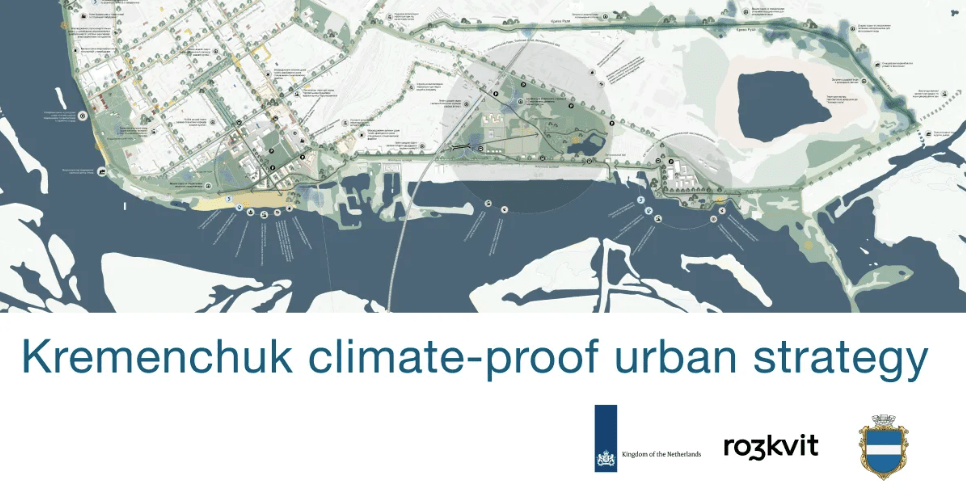
Then the team started working, and the waterfront revealed everything underneath it. Historic buildings were under threat of demolition. High-rise developments were planned in heritage areas, right next to the river. Civil society activists and real estate developers were locked in open conflict. And in the middle stood a municipality with limited capacity, unsure how to arbitrate between interests pulling in opposite directions. What had been framed as a landscaping question turned out to be a question of governance, memory, safety, identity, and climate, all at once.
“That’s where all the topics came together,” Svitlana explains. The strategy that emerged, the Climate-Proof Urban Strategy for Kremenchuk, deliberately refused to deliver a list of quick projects. It began instead with a diagnosis of the city as a living system, where water flows, industrial zones, housing, mobility, health, and cultural identity are analyzed together rather than separately. Systematic demolition was explicitly rejected. Existing structures, including the unloved industrial ones, were treated as resources to adapt and reinterpret, not debris to clear.
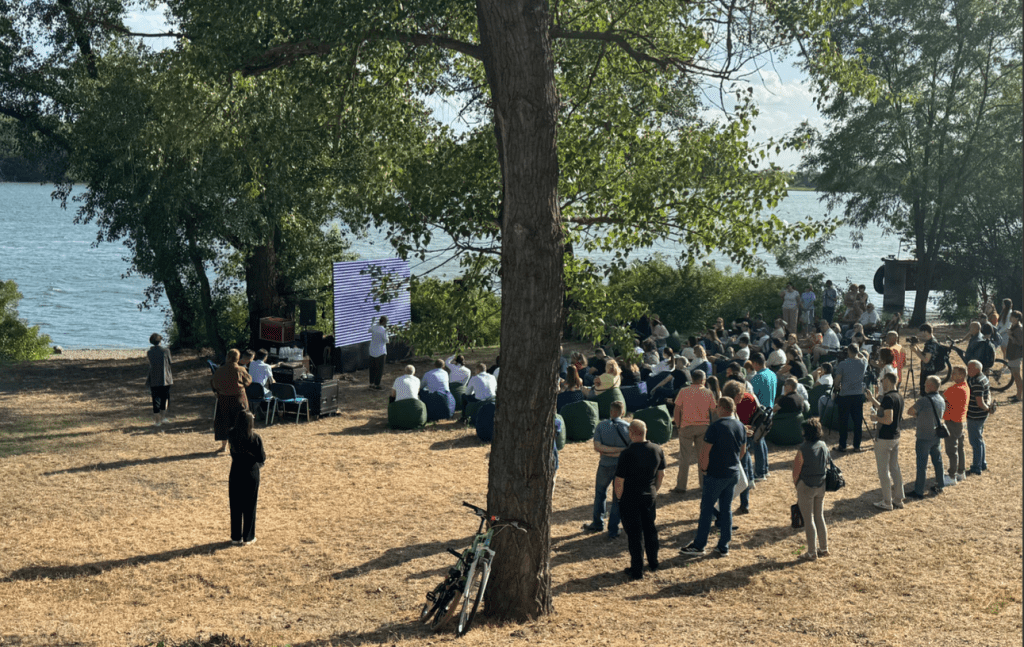
There is a method in this refusal. Ro3kvit does not build, and it does not sell masterplans. It works in the space that is usually missing in post-war contexts: the moment of strategic reflection and discussions with citizens before decisions become irreversible, when alternatives are still imaginable and conflicts are still visible. In Kremenchuk, success was measured less in renderings than in relationships. “We managed to build a very good relationship with local stakeholders. And this is a crucial part of the success of any such project,” she says. It sounds modest. It is, in fact, the whole point.
The Materials That POVTORNO Refuses to Waste
Svitlana’s other front is materials. Alongside her strategic work with Ro3kvit, she has led key work on POVTORNO, a ReThink platform dedicated to the reuse of construction materials including those salvaged from buildings destroyed by the war.
The premise is concrete. Ukraine faces destruction on a massive scale, which means enormous volumes of brick, wood, steel, and concrete. Most of it ends up in landfills. POVTORNO works to change that, not through industrial recycling, which requires infrastructure and years of development, but through direct reuse: dismantling carefully, assessing what can be recovered, and making it available again.

The platform functions as both a catalog and a knowledge base, designed primarily for architects and designers. It documents which materials can realistically be reused, how, and in which contexts. Soviet modular concrete panels, it turns out, are structurally among the most reusable elements, though the question of whether one wants to reuse them for housing is another matter. Bricks are durable but labor-intensive to recover. The greatest potential often lies not in structures but in facades and interiors, which connects reuse directly to a culture of restoration that Ukraine has barely developed.
But Svitlana understood early that a digital tool alone would not be enough. In Hostomel, a small town near Kyiv whose name the world learned in the first days of the invasion, the team opened a pilot storage space. People had been contacting the platform saying they had materials to give but nowhere to put them. The system, she concluded, must become local to become real.
Behind the logistics lies something deeper. She speaks of “embodied memory,” the idea that materials themselves carry history and continuity. In Poland after the Second World War, salvaged materials rebuilt entire cities. In Ukraine, the post-Soviet reflex runs in the opposite direction: old means bad, new means good. Convincing people that a recovered brick is not a mark of poverty but a vessel of continuity is, in its own way, a battle over memory.
Decolonizing the Planner, Not Just the Plan
It is on the question of decolonization that Svitlana’s thinking becomes most personal. As a Spotlight Fellow of the LINA European Architecture Platform, her research project, Decolonial Grounds of Ukraine’s Recovery, examines how colonial and Soviet legacies continue to shape planning practices and spatial hierarchies in Ukraine. But when she explains it, she insists on a distinction that rarely makes it into conference panels.
The first dimension of decolonization is external. It is the work of representation: making clear, to international audiences, what is Ukrainian and what is not Russian, giving voice to Ukrainian artists, architects, and thinkers. This work is necessary and nuanced, and since 2022 it has gained visibility.
The second dimension is internal, and harder. “In Ukraine, for a very long time, we were not fully aware that we were part of an empire,” she says. “This created a lot of inferiority complexes, the feeling that there is always a ‘great Moscow’ and that we are somehow not good enough.” This internalized hierarchy, she argues, has shaped how many Ukrainians think about their own cities, their own culture, their own legitimacy. For some, the process of dismantling it only began with the full-scale invasion. Decolonization, in other words, is not just about how others see Ukraine. It is about how Ukrainian society sees itself.
And then she turns the lens on herself. She studied in Milan. She inherited her frameworks from European institutions, her benchmarks in urban planning from senior Dutch colleagues. When she arrives in a Ukrainian municipality and explains what a “good” city looks like, she carries that inheritance with her. “You come to another context and you say: you should develop like in the Netherlands, or like in Denmark. And you start to realize that this is turning to become a top-down approach. And the knowledge is not neutral here. “
“When you come to a city and you say, you should do this, you should do that, the question is: what gives you the right to say this? Do you really understand this context well enough?”

It is a methodical doubt about expertise itself. Yet it is not paralysis. It is a discipline. Learning from locals rather than only teaching them, making trade-offs explicit rather than hiding them behind technical language, treating every imported model as a hypothesis to be tested against a specific place. The colonial reflex, she notes, is not a matter of where knowledge comes from but of how it is applied: the logic of imposing one way of doing things as the only valid one. Even good intentions can fall into it. The warning applies to everyone who will arrive in Ukraine with a masterplan.
While the Window Is Still Open
Toward the end of our conversation, the café has warmed up, or maybe we have simply stopped noticing. Svitlana checks her phone. There is work waiting. There always is. In Kremenchuk, the heritage buildings were still under threat. The high rises remained a possibility. The municipality was still being asked to choose what kind of city it wanted to become. The window is still open, and she knows better than anyone how quickly it can close. As we part ways in Montparnasse, I think of something she said earlier, almost in passing, about arriving in a Ukrainian city with her European training. “This knowledge is not neutral.” Five words that will stay with me longer than the rest.
—
Echoes from Ukraine / Valentin Jędraszyk
To learn more about the organizations mentioned in this article: Ro3kvit Urban Coalition for Ukraine, ReThink, POVTORNO, LINA European Architecture Platform.
 Echoes from Ukraine
Leave a comment