Since the first days of Russia’s full-scale invasion, Ukrainian firefighters and rescue teams have been fighting a war within the war. Missile and drone strikes hit residential buildings and critical infrastructure, then return minutes later to the same coordinates as first responders arrive. These so-called double strikes are not collateral damage. They are a deliberate tactic designed to turn rescue itself into a target, increase casualties, and erode civilian resilience. In today’s Ukraine, saving lives can be as lethal as being on the front line. It is in this reality that a small French industrial company found an operational role in Ukraine. Founded in 2016 in La Rochelle, Shark Robotics designs ground robots built to go where humans cannot. In 2025, the company delivered forty Colossus, its flagship intervention robot, to Ukraine’s State Emergency Service, enabling rescue teams to enter strike zones immediately after an attack while reducing human exposure. The deployment became the first project fully finalised under the Fonds Ukraine, a €200 million French-Ukrainian mechanism addressing urgent civilian needs. I spoke with Cyrille Kabbara, founder and CEO of Shark Robotics, about the origins of his company, the operational logic behind its deployment in Ukraine, the impact observed on the ground, and how lessons drawn from the war are now shaping its long-term industrial trajectory.

Designing Technology to Reduce Human Exposure
Shark Robotics was built on a simple operational conviction: send machines where humans should not have to go. Cyrille Kabbara reached that conclusion well before the full-scale war in Ukraine, shaped by years of military service and operational deployments in Afghanistan and Africa. During that time, he observed a striking asymmetry. Robots were already widely used for demining, explicitly to limit human exposure, while firefighters and civil protection teams were still expected to enter collapsing buildings, burning industrial sites, or contaminated environments themselves. After leaving the army, Kabbara pursued an MBA in intelligence économique, seeking to transfer military operational reasoning into civilian industry. The thesis behind Shark Robotics emerged from that transition. If machines could take the first step in minefields, he asked, why not in fires, industrial accidents, or chemically degraded sites? The answer materialised in Colossus, a heavy, remotely operated ground robot designed for firefighting and high-risk civil protection missions.
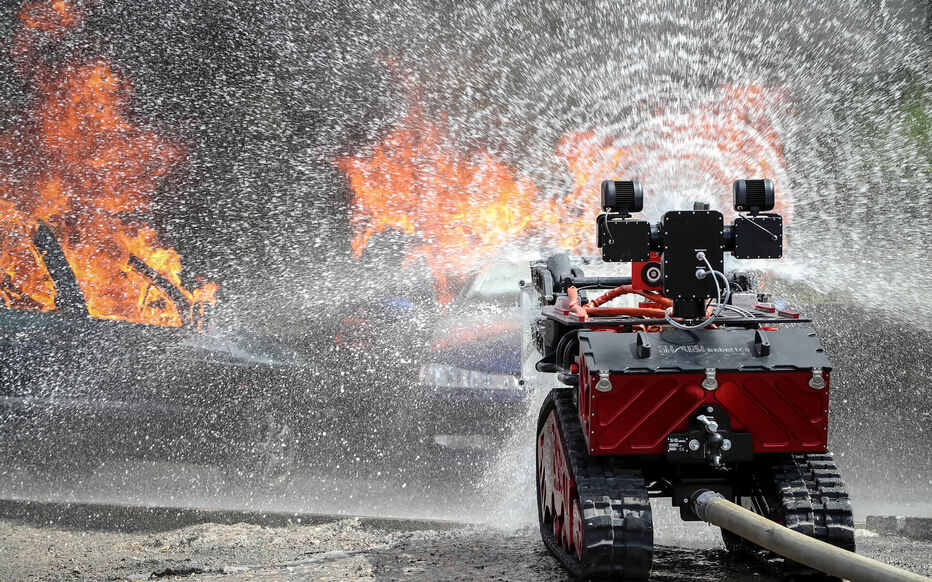
Its development relied on deep industrial integration, with hardware, software, assembly, and batteries brought in-house to ensure robustness and maintainability in extreme conditions. That approach was validated in 2019 during the fire at Notre-Dame de Paris, where Colossus operated for nearly ten hours in support of the Paris Fire Brigade. By the early 2020s, the company had established itself as a credible civil protection actor, with more than 90 percent of its activity driven by exports, several hundred robots delivered, and deployments in over twenty-five countries.

From Civil Use to Wartime Deployment
This operational track record opened the path to Ukraine. The move came from the field, not from strategy. Ukrainian firefighters first encountered the Colossus robot during training in Poland, where it was already in active service, establishing Shark Robotics’ credibility in real crisis conditions. In 2024, that credibility led Ukraine’s State Emergency Service to approach the company for an immediately operational, war ready deployment. For Cyrille Kabbara, committing production capacity to Ukraine was not without risk, but the alternative, remaining on the sidelines while the need was clearly identified, was not considered an option.
The project was selected as the first awardee under the Fonds Ukraine, a €200 million mechanism overseen by the French Treasury, designed to translate operational priorities identified by Ukrainian authorities into rapid and tangible deliveries. Within this framework, the Shark Robotics project was approved for approximately €14.5 million, enabling the delivery of forty Colossus robots to Ukraine’s State Emergency Service, along with training and operational integration.
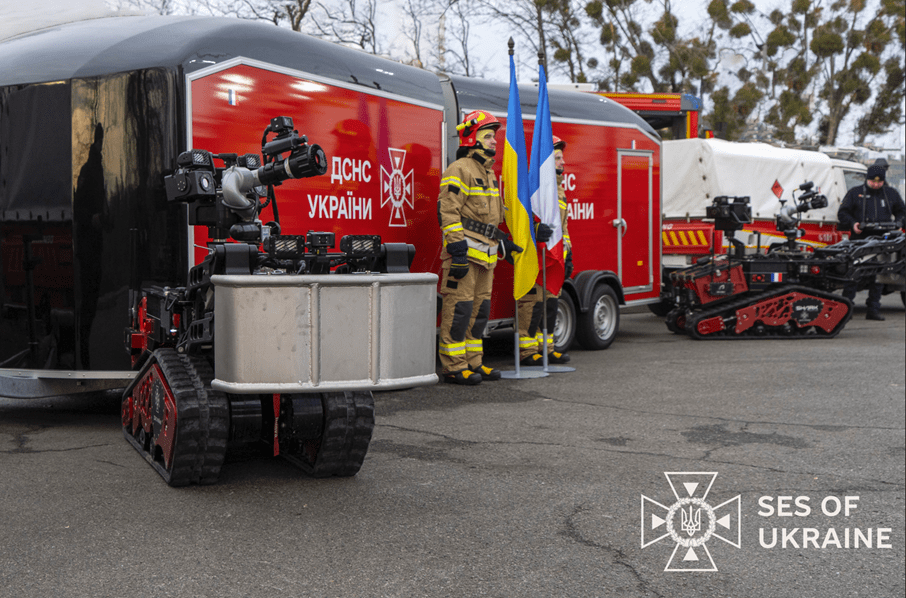
Execution followed an accelerated timetable. The robots were delivered between the spring and autumn of 2025, with immediate deployment. Production and delivery were completed in seven months, an exceptional pace representing roughly half of Shark Robotics’ annual production capacity. To meet the deadline, the company temporarily reconfigured its industrial organisation, operating under constraints on components and logistics. For Shark Robotics, the deployment marked a transition from civil emergency response to sustained operation in a war environment, compressing years of operational feedback into a matter of months.
Redesigning First Response: Evidence from the Field
On the ground, the deployment of Colossus is changing how emergency interventions begin. Integrated into the daily operations of Ukraine’s State Emergency Service, the robots are sent in immediately after a strike to enter damaged or burning buildings, cool fires, clear debris, open access routes, and assess structural stability before human crews follow. Shark Robotics has described the robots as used across multiple oblasts, particularly in the aftermath of airstrikes.
This sequencing has become critical in the context of deliberate double strikes, in which a second attack is timed to hit the same location as rescuers arrive. In such scenarios, the first minutes after impact are often the most lethal. Speed remains essential, but speed without prior assessment exposes teams to unacceptable risk. By inserting a machine into that window, emergency services can delay human engagement until risks are clearer, rather than committing personnel blindly into unstable and potentially lethal environments.
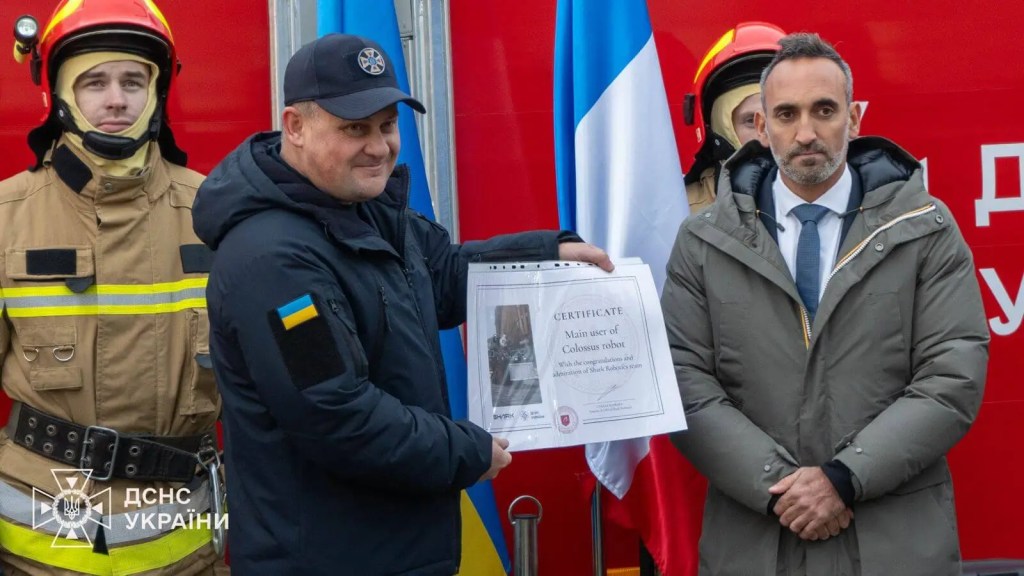
According to Andriy Danik1, Director General of Ukraine’s State Emergency Service, the forty robots delivered have made it possible to conduct operations in highly dangerous environments while significantly reducing direct exposure of rescue teams during the most critical phase of intervention. Operational feedback from units equipped with Colossus indicates that casualties among rescue teams are reported to have been reduced by a factor of three2. These figures carry particular weight in a war environment, where technology is judged by its ability to function reliably under fire and where success is measured in exposure avoided and lives preserved.
Building Sustainable Capacity
The delivery of the first forty robots marked a starting point rather than a conclusion, revealing the true scale of the operational need. To ensure continuous coverage across regions regularly exposed to strikes, Ukrainian authorities estimate that a nationwide fleet of around one hundred and sixty robots would ultimately be required. The question is no longer whether such systems are useful, but how they can be sustained, maintained, and expanded over time within an emergency service operating under permanent strain.
Operational feedback from Ukraine has shaped the next phase of development. Lessons from sustained use under fire fed directly into the Colossus Gen 2.4, unveiled at Milipol, the Paris-based international exhibition dedicated to internal security and civil protection3. The new version is more powerful, faster at over ten kilometres per hour, more agile thanks to a suspended track system, and features reinforced communications designed to operate despite electronic warfare, including GPS disruption and signal jamming. Shark Robotics is also progressively integrating artificial intelligence components for semi-autonomous navigation and improved data collection, with Ukrainian teams contributing directly through continuous field feedback.

Beyond technology, discussions are now moving toward industrial presence. Shark Robotics and Ukrainian counterparts are exploring the creation of a local joint venture focused on maintenance, operator training, and long-term support, with the prospect of assembling or producing certain sub-assemblies in Ukraine. For Ukrainian authorities, this would shorten maintenance cycles and secure operational continuity. For Kabbara, it marks a shift from emergency delivery to a durable industrial partnership, embedding capability locally while preparing for future scaling.
* * *
What began as an emergency deployment is evolving into a durable industrial logic rooted in Ukraine. Local production reflects both operational necessity and the resilience of Ukrainian teams, positioning the country as an industrial contributor rather than a passive recipient. For Shark Robotics, the objective is to strengthen civil protection in Ukraine while enabling components or systems produced locally to re-enter European markets, carrying a level of maturity forged under conditions no simulation could replicate.
More broadly, the experience points to a shift in how French industry engages in Ukraine. Through mechanisms such as the Fonds Ukraine, support is moving beyond emergency assistance toward structured industrial cooperation, where speed, depth, and accountability matter as much as innovation. In this framework, Ukraine becomes not only a theatre of urgent need, but a proving ground shaping the future contours of French and European industrial resilience.
—
Echoes from Ukraine / Valentin Jędraszyk
- Shark Robotics, Ukraine celebrates deployment of 40 Colossus robots to strengthen resilience against drone attacks, 2025 ↩︎
- Shark Robotics, operational feedback shared by SESU units, 2025 ↩︎
- EDR Magazine, Milipol 2025: Shark unveils Colossus 2.4, 2025 ↩︎
 Echoes from Ukraine
Leave a comment