Il s’agit d’une traduction de l’article en langue anglaise. La version originale en français est disponible ici.

A Ukrainian Interlude in the Budgetary Storm
On a cold November afternoon, the Senate is gripped by the tense rhythm of the debate on the Finance Bill. Procedural interruptions, last minute arbitrations, and the absence of a clear majority in the National Assembly turn the corridors of the Luxembourg Palace into something resembling a crisis room. It is in this context that Nadia Sollogoub, Senator for Nièvre since 2017, receives us with Lyubov in the Victor Hugo Salon, a room adjoining the chamber. Her phone keeps vibrating, but she sets it aside before the interview begins. “We are caught up in the Finance Bill, but we cannot decide that the war will wait,” she says simply. As the institutional machinery accelerates around us, she preserves a space devoted to Ukraine, a matter she has followed daily for several years now.
A Relationship Built Late, Revealed by War
Nadia Sollogoub’s connection to Ukraine took shape gradually. While her family background is rooted in a broader set of Slavic cultures, Ukraine did not initially hold a central place. Her first trip to Kyiv, as a young adult, offered her a glimpse of the country, without yet revealing its full complexity. The real turning point came in 2020, when she became Chair of the France–Ukraine Friendship Group in the Senate. As she met Ukrainian officials, she discovered a relationship to the world, to humor, to social life that differed from her original points of reference. “I built my Ukrainianness through contact,” she summarizes. The invasion of February 24, 2022 radically changed the framework. At dawn, a video reached her from Kyiv: it showed Ludmyla Buimister, a member of the Verkhovna Rada and Chair of the friendship group on the Ukrainian side, filmed from a shelter, helmet on, body armor over her shoulders. The light flickered on the walls, her voice was subdued. The image struck her deeply. This was the true emotional turning point, when the war left abstraction and entered her parliamentary daily life. The parliamentary link became human support.

The Senate’s Discreet Diplomacy and the Central Role of the France–Ukraine Friendship Group
Within the Senate, the France–Ukraine Friendship Group has become the main interface for Nadia Sollogoub’s work on the war. As its Chair, she organizes regular exchanges with Kyiv, coordinates with ministries, and responds to requests from local authorities, hospitals, universities, and associations. “We work a lot, but without cameras, without tweets,” she sums up. She has chosen to focus her action on civilian dimensions such as humanitarian aid, social protection, and support for refugees, leaving military issues to specialized committees. This positioning gives the friendship group a central role. It becomes the space where numerous Franco Ukrainian solidarities are connected, structured, and strengthened, solidarities that would otherwise often remain fragmented without this discreet coordination.
Many Ukraine related initiatives pass through Nadia Sollogoub’s office, where she helps facilitate contacts, guide stakeholders, and provide an institutional framework for projects already underway. Several technical cooperations illustrate this. Since 2022, SNCF has provided sustained support to Ukrainian railways through expertise, equipment, and logistical assistance, a file she follows closely. Other initiatives originate locally, such as the training in Aix en Provence of eight Ukrainian firefighters, led by a French national based in Odesa and supported by the senator to mobilize local authorities and emergency services. Nursing schools and the Red Cross, involved in training Ukrainian healthcare workers, also find in her a useful institutional relay. These actions, sometimes discreet when viewed individually, have very concrete effects: strengthening fire brigades, supporting hospitals, helping schools, building professional skills. Together, they form a set of French commitments to which the senator helps give continuity and clarity.

Local Authorities, a Discreet Pillar of Support
Local authorities play a major role in supporting Ukraine, and Nadia Sollogoub closely follows how they organize themselves to act. The Senate, she recalls, is an institution designed to be closely connected to territories, and its role is also to observe, accompany, and understand local dynamics. She notes that municipalities, departments, and regions often take very concrete initiatives: sending generators, supporting schools, hosting children, or launching cultural projects. “Municipalities move faster than ministries,” she observes, highlighting their ability to decide quickly and mobilize their networks.
Some cities structure sustained engagement. In Dijon, a local network, notably around Olha Mala, maintains regular ties with Ukrainian partners through educational, cultural, and associative initiatives. Elsewhere, in smaller towns, municipal councils finance the shipment of emergency equipment or initiate twinning projects meant to last. By following these actions and ensuring their coherence with needs expressed from Ukraine, the senator plays a role of institutional oversight that complements state action and allows local authorities of all sizes to contribute in a targeted way.
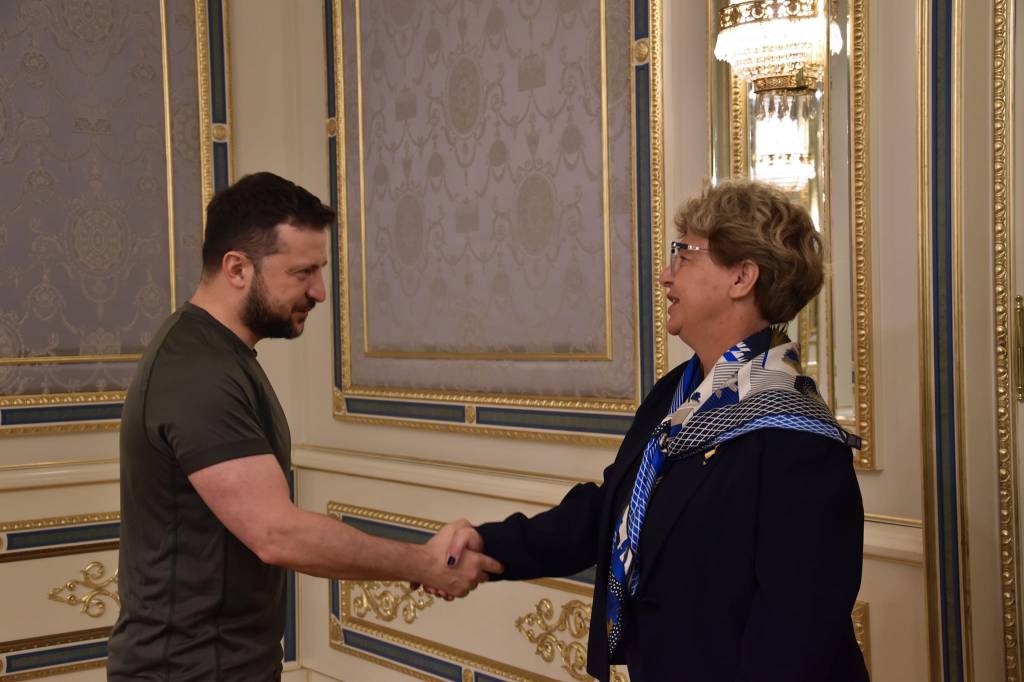
The Challenges of Temporary Protection and Reception in France
Since 2022, the senator has repeatedly raised the alarm about the limits of the temporary protection scheme activated by the European Union to receive Ukrainians. Designed as a rapid and transitional measure, it provides an initial level of support but leaves many gaps. The first difficulty is administrative. The status must be renewed every six months, a pace that is difficult for already overstretched prefectures to sustain. Many experience these repeated procedures as a source of constant anxiety, with little visibility on timelines. Added to this are more structural obstacles. The recognition of diplomas runs into slow and fragmented procedures. Nurses, engineers, teachers, or technology specialists must restart processes upon arrival in France or wait a long time for equivalence. Access to social benefits is also limited. The allowance granted to beneficiaries of temporary protection is often insufficient. People with disabilities struggle to obtain appropriate benefits, and elderly people cannot access the personalized autonomy allowance. These shortcomings leave the most vulnerable groups with incomplete protection.

These difficulties ultimately produce the same outcome. Many beneficiaries abandon temporary protection and turn to asylum, not because it reflects their situation, but because it becomes the only way to access certain essential rights. “We are pushing people toward a status that is not made for them,” she summarizes. To put a human face on this reality, she takes out a letter from Yuri and Nina, a retired couple from Donetsk now living in Béthune. They recount their last visit to the Arras prefecture. In the past, fifty to sixty Ukrainians would come each day to renew their status. In November, there were only nine. Most of the others had already filed asylum applications. As she folds the letter, her voice softens slightly. In a few lines, the couple describes the exhaustion caused by a system meant to protect but that ends up pushing its beneficiaries, worn down, toward a procedure that does not fit them.
In response, she sponsored a bill aimed at better aligning rights between temporary protection and asylum, to prevent these forced shifts and restore the scheme’s original coherence. Adopted by the Senate, it is now awaiting examination by the National Assembly. Elected from a rural department, she also points out that reception outside major cities presents additional challenges: reduced mobility, isolation, more complex procedures. Yet she also cites trajectories that show integration remains possible, such as that of a young Ukrainian woman who arrived in Nièvre, continued her studies, and later became her collaborator in the Senate. “These trajectories matter,” she insists.
Narrative Stakes and the Ukraine of Tomorrow
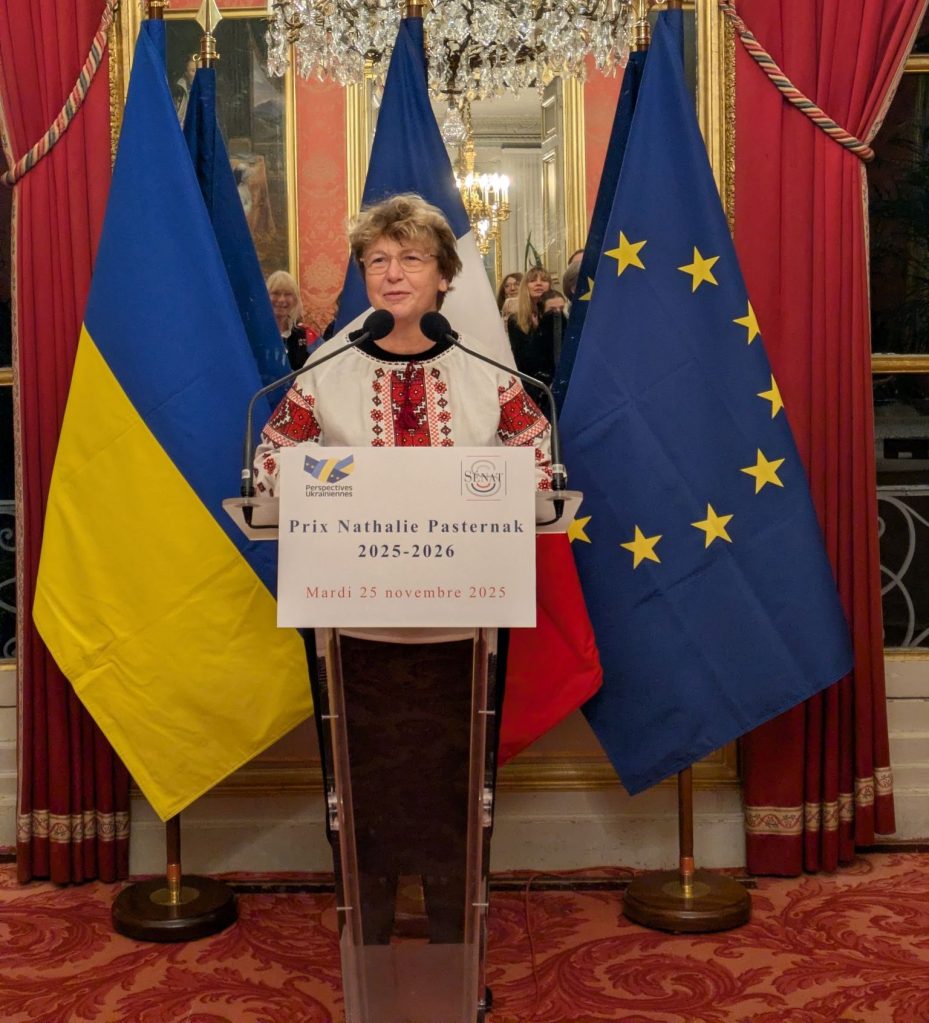
In continuity with her engagement, Nadia Sollogoub stresses the importance of showing an Ukraine that continues to create, innovate, and tell its own story beyond the war. She evokes young designers working despite power cuts, artists reinterpreting traditional motifs, filmmakers documenting the country’s trajectory. She recalls in particular a fashion collection sewn in a cellar by flashlight and later presented at the Ukrainian Cultural Center in Paris, one example among many of this creativity that persists despite blackouts and war. Among the initiatives that give this visibility, she cites the Nathalie Pasternak Prize, organized each year at the Senate at the initiative of the association Perspectives ukrainiennes. She awarded this prize the day before our interview. The latest edition honored a documentary devoted to Volodymyr Zelensky, offering a more nuanced and embodied view of his journey.
This cultural dimension feeds a broader reflection on the country’s future. The senator mentions the demographic question, the concern of a youth dispersed by war, and the need for an economic rebound capable of encouraging returns. She underlines that France has assets to support this reconstruction: the involvement of its local authorities, the capacity of its training institutions, the expertise of its technical networks. The Senate, less exposed to political swings than the executive, can anchor these ties over the long term and offer diplomatic continuity. “Ukraine is already part of Europe,” she states. What remains is to consolidate the frameworks that will anchor this reality.
Back to the Chamber
A notification sounds. The senator stands up. The chamber calls her back for a vote. She gathers her files and leaves the salon at a brisk pace. In the corridor, parliamentary flow resumes. Amid figures, budget lines, and fiscal balances, Ukraine remains in the background, discreet yet constant, like a thread she refuses to let go.
—-
Echoes from Ukraine / Valentin Jedraszyk & Luybov Smachylo
 Echoes from Ukraine
Leave a comment