Vice President of InfraNum, the French federation of digital infrastructure companies, and founder of Teleos, a telecom operator and integrator serving businesses and public clients, Philippe Le Grand wants to put a proven French model at the service of Ukraine’s reconstruction. In Khmelnytskyi, in the west of the country, he is preparing with his Ukrainian partner HomeNet an open-access fiber network that is neutral and open to all operators. Backed by French public authorities, the project aims to make up to half a million homes serviceable. Beyond the numbers, the goal is clear: keep digital life running during the war and prepare the economic recovery.
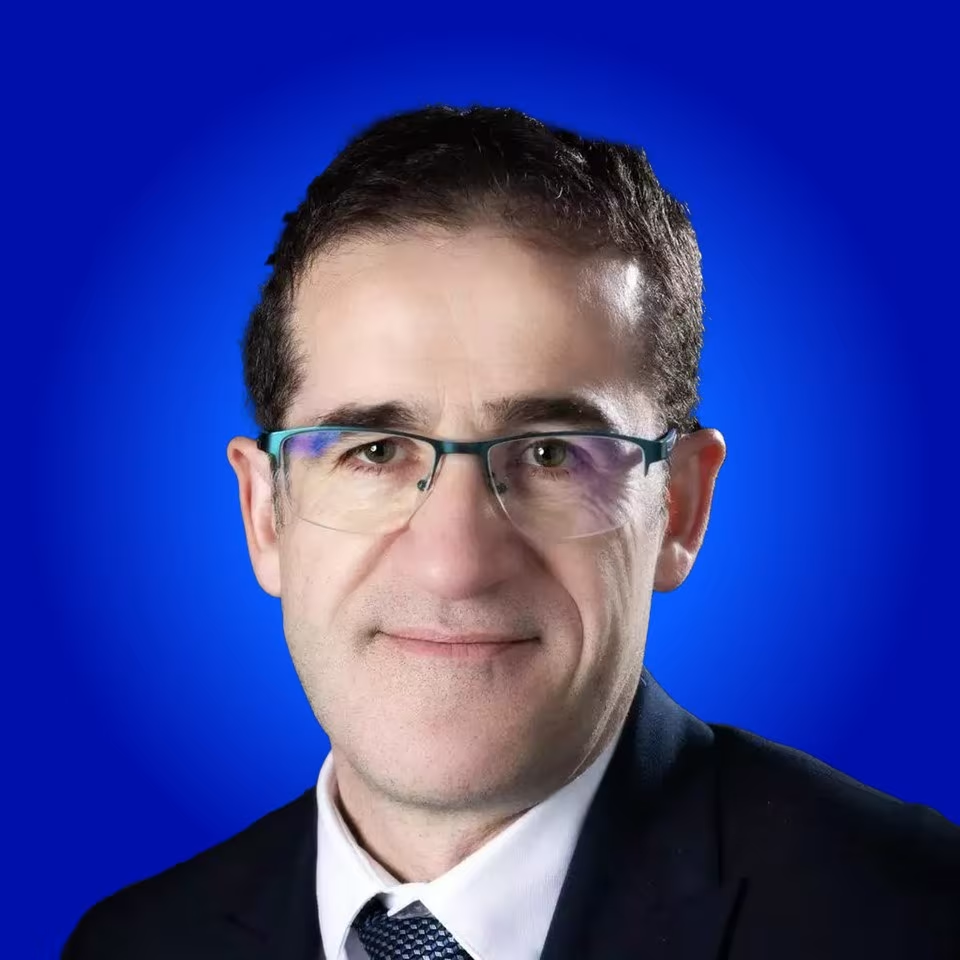
Philippe Le Grand, CEO of Teleos and Vice-President of InfraNum, the French federation of digital infrastructure companies.
A $50 Million French Investment to Rewire Western Ukraine
Philippe Le Grand knows the French digital infrastructure chain from the inside. He led InfraNum for three years, the federation that brings together about two hundred companies active in fiber deployment, mobile networks, and data center infrastructure. Since December 2024 he has stepped down as its vice president. In parallel he founded Teleos, a telecom company for business and public clients that designs, deploys and operates fiber networks.
Like many Europeans, Philippe Le Grand was deeply moved by the full-scale invasion of Ukraine in 2022. “I don’t know how to fight a war,” he says, “but I know how to build networks. That’s my way of helping.” His project in Ukraine grew from that conviction: to use what he knows best, digital infrastructure, to help a country under attack stay connected and prepare for recovery.
In Rome this summer, at the Ukraine Recovery Conference, he signed a $50 million agreement between Teleos and Ukrainian operator HomeNet. The partnership centers on the Khmelnytskyi oblast in western Ukraine, a region chosen for both its strong demand for high-speed connectivity and its strategic position within the country. The goal is ambitious yet clear: to deploy an open-access fiber network to make up to half a million homes serviceable across the oblast. Teleos will not only design and build the network’s infrastructure but also act as a retail operator, delivering internet and communication services directly to households and businesses.
Rebuilding Ukraine’s Digital Backbone under Fire
Ukraine’s telecom landscape is vast but deeply fragmented. The country counts nearly 7,000 operators, grouped into about 1,500 entities. Most are small and local providers operating far below the scale needed to generate margins for long-term investment. Yet Ukraine is far from a digital desert. On several indicators, it performs relatively well compared with its neighbors; Philippe Le Grand cites Romania and the Netherlands as points of reference. The real challenge lies in the slowdown of investment since 2014, a trend worsened by the full-scale invasion in 2022. War has increased operational risks, disrupted supply chains, reduced insurance coverage, and heightened exposure to currency fluctuations. In such an environment, small and scattered operators struggle to consolidate or finance infrastructure that requires stability, scale, and time.
The partnership between Teleos and HomeNet brings two worlds together. From France come the methods, standards, and project discipline built over years of national fiber deployment. From Ukraine come the people who will make it real on the ground, the teams that will install, maintain, and operate the network every day. Together they apply a simple idea tested in France: build one shared infrastructure that any operator can use, guarantee open access, and keep quality consistent through common service standards. It is a practical model of fairness and efficiency, now carried into a country at war. The first pilot, launching in November 2025, will connect around 1,000 to 2,000 homes. It will test the model’s technical design and cost assumptions before scaling up to reach 500,000 households over the next three years.
France’s Financial Tools for Ukraine’s Reconstruction
France has long relied on a combination of public funding and private initiative to open new markets and mitigate investment risk. In Ukraine, this approach is proving decisive. French public instruments make it possible to engage early, test operational models, and prepare large-scale industrial projects ahead of post-war stabilization. Among these mechanisms, the FASEP program, managed by the French Treasury, plays a central role. It supports feasibility studies and pilot operations that validate technical and financial assumptions before full deployment. In Khmelnytskyi, a €756,000 FASEP grant enabled Teleos to carry out market analysis, engineering studies, and an initial field deployment, confirming the project’s technical design and cost structure as part of a $50 million investment plan.
For investments of this scale, other levers of French and European support can be activated, notes Philippe Le Grand. In early 2025, Bpifrance strengthened its support for banks involved in projects in Ukraine, raising the guaranteed share to 97.5 % across all export credit and investment insurance products. This exceptional level includes coverage of political risks linked to the war, enabling commercial banks to keep financing projects in a high-risk environment. The remaining 2.5 % could be covered by instruments from the European Investment Bank, creating near-total protection for lenders and lowering the overall cost of capital. Together, these tools form a framework of confidence, where public trust and private initiative reinforce each other to make progress possible, even in wartime.
Seizing the Window of Opportunity to Enter the Ukrainian Market
For Philippe Le Grand, the time to act for French companies is now. Waiting for peace, he warns, would mean arriving too late. After the war, Ukraine will see a surge of international investment, a wave likely to be led by the United States, followed by China and other powers competing for position in a rapidly growing market. Those who have not learned the terrain or built partnerships on the ground will have lost valuable time.
Beyond financial instruments, French companies can rely on the full strength of France’s economic diplomacy: the economic service of the French Embassy in Kyiv, Business France, Bpifrance, Medef International, the French Chamber of Commerce and Industry in Ukraine, and the network of French Foreign Trade Advisors (CCEF). Acting now is both a gesture of solidarity and a strategic move, a way to contribute to Ukraine’s recovery while ensuring France retains a meaningful voice in the new economic landscape that will follow. Philippe Le Grand also recommends working closely with the many consultants, business lawyers, and advisors in France who know the Ukrainian market and can help navigate its operational and legal complexities.
Yet beyond the frameworks of diplomacy and finance, what gives meaning to all these efforts are the people themselves. What strikes Philippe Le Grand the most is the resilience of the people he meets. “In every evening shared with Ukrainian partners,” he says, “there is both laughter and tears, a mixture of sorrow and determination that defines the country’s spirit.”
 Echoes from Ukraine
Leave a comment