On 13 October 2025, the Ukrainian Cultural Center in Paris hosted the conference Voices of Survival, organized by the Embassy of Ukraine in France, the Ombudsman of Ukraine and the Embassy of Norway. The event focused on one of the most urgent humanitarian dimensions of the war: the treatment of Ukrainian prisoners of war and civilian detainees held by the Russian Federation in violation of international law. The discussion brought together representatives of Ukrainian institutions, diplomats and survivors to present the scale of Russia’s violations and Ukraine’s efforts to confront them through documentation, transparency and law.
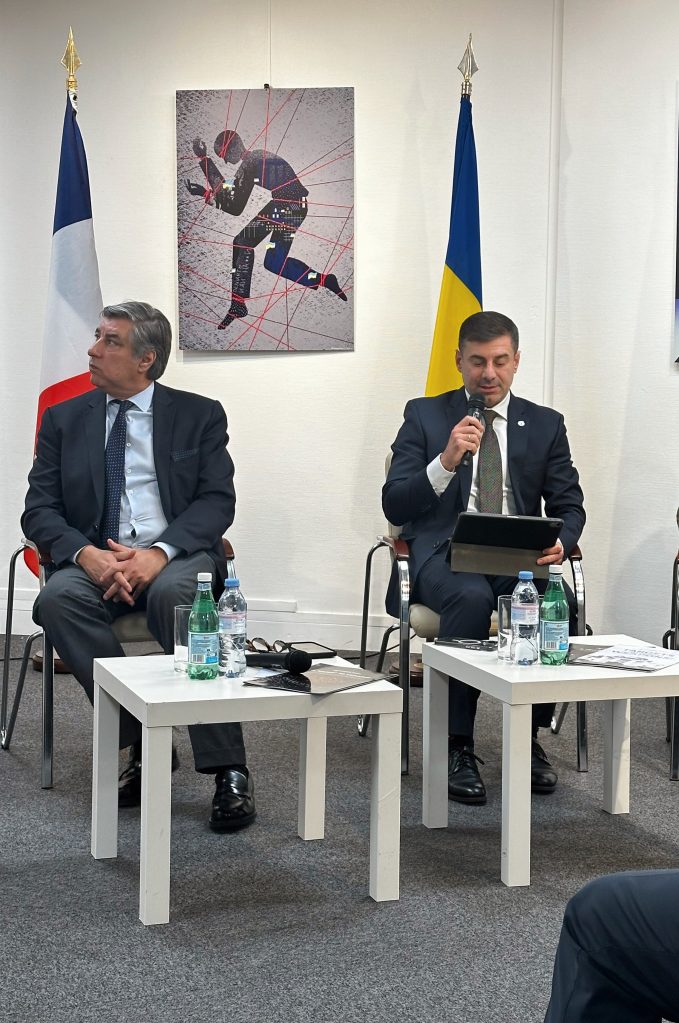
The Ambassador of France to Ukraine with the Ukrainian Parliament Commissioner for Human Rights during the conference “Voices of Survival” in Paris (13/10/2025)
A System of Captivity and Erasure
The conference Voices of Survival, held in Paris on 13 October 2025, marked the visit of Dmytro Lubinets, the Ukrainian Parliament Commissioner for Human Rights, and highlighted Ukraine’s efforts to defend law and humanity in wartime. As the Ombudsman emphasized, since 2014 the Russian Federation has built a system of control across occupied territories rooted in deportations, forced assimilation and the systematic abuse of civilians. Over time, it has evolved into a machinery of captivity and identity erasure that targets both individuals and entire communities, affecting children, civilians and prisoners alike.
Among the most vulnerable are Ukrainian children, with at least 20,000 officially identified as deported to the Russian Federation, a figure that likely represents only a fraction of the true scale. The deportation process follows a consistent pattern: forced transfer from occupied areas, replacement of Ukrainian documents with Russian ones, placement of children in Russian families, and indoctrination through militarized youth programs intended to erase their national identity. The final stage is ideological, convincing children that Ukraine never existed as a nation and that they have always been Russian. In liberated areas such as Kherson, investigators have uncovered torture sites used against minors. Children were detained in isolation, threatened and subjected to propaganda designed to destroy their sense of belonging.
The same pattern of violence extends far beyond children. Across occupied territories, civilians are subjected to the same machinery of disappearance and coercion. More than 16,000 people remain officially listed as missing, and around 1,800 are confirmed to be held in Russian custody, including employees of international organizations.
Among the speakers was a 25-year-old woman who had survived two years of Russian captivity after being captured while fleeing Mariupol in 2022. She had been held across seven different detention sites and described the deprivation, humiliation and torture that defined daily life for prisoners. Detainees were forced to sing the Russian anthem each morning and to glorify those who had attacked their city. She spoke of starvation, electric torture and the deaths of fellow captives. For two years, her family had no information about her fate. What she recalled most vividly was uncertainty, the constant awareness that each interrogation might be her last. Her testimony, calm and precise, mirrored the experience of thousands of Ukrainians still in captivity and served as a call to maintain international attention on their conditions and their rights.
The same fate has befallen Ukrainian prisoners of war (POWs), thousands of whom remain unaccounted for or are held in conditions that defy every principle of international law. Investigations reveal that more than 95 % of captured Ukrainian soldiers have endured physical or psychological torture, starvation, and the systematic denial of medical care. Many have perished in captivity or are presumed dead, while their families wait in silence for news that almost never comes.
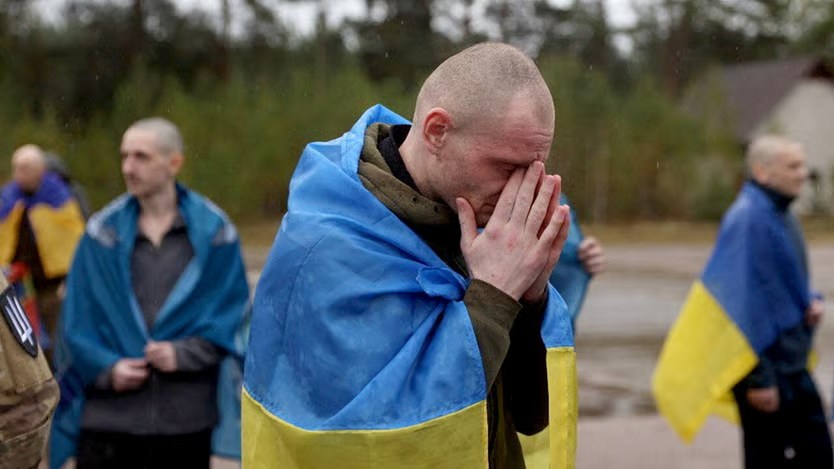
Ukrainian POW / Photograph: Reuters
Law and Humanity in Wartime
Ukraine continues to work to bring them home. Through national and international coordination under the Ombudsman’s Office, 6,235 Ukrainians, including more than 300 civilians, have been successfully returned from Russian captivity under humanitarian mechanisms defined in President Zelensky’s Peace Formula.
At the conference, Ukraine’s representatives underlined that the state’s response to these crimes is not only military but legal and institutional. The Ministry of Defence of Ukraine has developed a comprehensive framework for the implementation of international humanitarian law, ensuring that Ukrainian forces operate within the boundaries of legality even under constant attack. This framework is coordinated by the International Law Branch at the Ministry of Defence of Ukraine. This department trains personnel, monitors compliance and investigates both Russian and Ukrainian violations to ensure accountability and integrity.
The Ministry’s Voluntary Report on the Implementation of International Humanitarian Law is a public document that demonstrates how humanitarian law is integrated into command structures, operational planning and battlefield decisions. The report also serves as a transparency mechanism for partner states, confirming that all weapons supplied to Ukraine are used in accordance with international law.
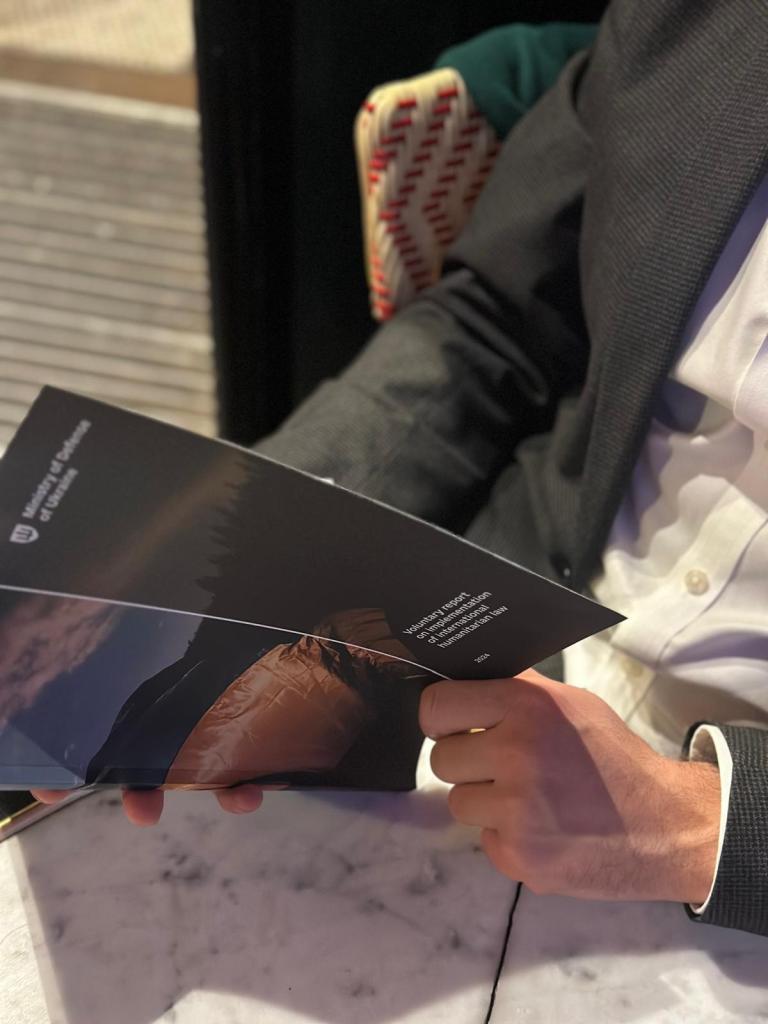
The Ministry of Defense’s Voluntary Report on the Implementation of International Humanitarian Law
It was emphasized that legality and humanity are not theoretical principles but operational realities. Drones and other technologies are used not only for defense but also to deliver medical supplies, transport blood, evacuate civilians and assist wounded soldiers, including Russians captured in combat. These examples illustrate that the rule of law and respect for human life remain at the core of Ukraine’s military conduct.
Ukraine’s struggle is fought on many fronts, not only in the defense of its land, but in the protection of law, memory and human dignity. The crimes of deportation, disappearance and captivity reveal the scale of violence; the country’s response shows the opposite force of order and conscience. Through its institutions, its soldiers, and those who survive to testify, Ukraine continues to prove that even in war, humanity is not lost. It is defended every day, and by choice.
 Echoes from Ukraine
Leave a comment