When the full-scale invasion of Ukraine began in February 2022, journalist Anna Olytska was finally where she had dreamed of being: established, independent, and creative. After years as a familiar face on Novyi Kanal, one of Ukraine’s leading TV stations, she had just launched her own YouTube platform. She had sponsorships lined up, a growing audience, and ambitions that reached far beyond Kyiv. Then the missiles came. “I had big plans, I had contracts with brands, and finally my YouTube channel was ready to work,” she says. “And suddenly, everything broke.” A year later, she found herself starting again in New York, with her son, a suitcase, and a voice the war could not silence.

Anna Olytska in New York, where she rebuilt her life and voice after leaving Kyiv in 2022
Growing Up in the Heart of Industrial Ukraine
Anna was born in Dniprodzerzhynsk, an industrial city in central Ukraine on the right bank of the Dnipro River. After the Euromaidan revolution and the country’s decommunization process, it regained its historical name, Kamianske. Home to 240,000 residents before the war, its skyline is shaped by steel and chemical plants.
Her mother, a mathematics teacher from Belarus, and her Ukrainian father separated when she was six. “I grew up without a father,” she says. “It was my mother and my grandparents who raised me.” The environment was strict, practical, and gray, not exactly the soil where one expects a future TV journalist to bloom. But even as a child, she dreamed big. “I was very ambitious, very competitive. But in a good way. I always competed with myself.”
At school she excelled, consistently graduating at the top of her class, while her mother pushed her toward a serious education. Yet outside the classroom, her real passion was music. “Since I turned eleven, I wanted to be a singer, a big star. I took vocal lessons, watched endless videos of performers, and went to every contest I could find.” She laughs remembering those years. “I traveled all over Ukraine with my mom, chasing every karaoke competition. And every time, I got second or third place. Never the first.” Once, in Crimea, she lost her voice just before the final. “They were ready to give me first place,” she says. “But I couldn’t sing.” She pauses, half amused, half nostalgic. “I think that was life telling me something.”

Before journalism, Anna dreamed of a stage career and spent her teenage years chasing music contests across Ukraine.
Choosing a Path Between Reason and Dream
At seventeen, she had to choose between two paths, one leading toward art and performance, the other toward stability. Following her mother’s advice, she entered the Institute of International Relations in Kyiv, a school known for producing Ukraine’s diplomats and political elite. For her, it was like stepping into another universe. “I was from a small city,” she recalls. “To get there, I had to study for a year with university tutors. Every month, my mom and I took the train to Kyiv for lessons.”
She made it in. The studies were prestigious, but they weren’t for her. “It was interesting, but I could feel my creative side fading.” After a short internship at the Ministry of Foreign Affairs, she left. The rhythm and atmosphere of that world simply didn’t suit her. Instead, she joined a music PR company, handling publicity for Ukrainian artists. It brought her closer to the world of show business she had always loved.

Graduating from the Institute of International Relations in Kyiv, where she first learned to see the world beyond her hometown.
Finding Her Voice on Ukrainian Television
Then one day, she saw a casting call for a new show on Novyi Kanal, one of Ukraine’s major national networks. “They needed reporters for an entertainment program, people who could speak, move, ask good questions. I wasn’t a journalist. But I decided to try.” The audition went well. “From the first day, all the doors opened,” she recalls. “It felt natural. I understood that journalism is not only about education. It’s about personality, character, and energy.”
For the next eight years, she became a familiar face to millions of viewers across Ukraine. She worked on programs covering show business, social issues, and eventually politics, including reporting from the Verkhovna Rada, Ukraine’s parliament. “I guess it became a mix of my two worlds,” she says, “political education and creative instinct.” Her style was direct, bold, sometimes disarming. “If you want to be a journalist, you have to know your goal, be confident, and not be afraid,” she says. “I was always the first to ask, sometimes other reporters hated me for that.”
Among thousands of interviews, “maybe ten thousand,” she laughs, one in particular, the first, stayed in her memory. “It was with Oleksandr Ponomaryov, a famous Ukrainian singer. I was trembling, I didn’t even know my questions by heart. But I did it.” She also recalls interviewing Donald Trump and Mick Jagger. “They’re just people,” she says. “You just need the courage to go and talk to them.”
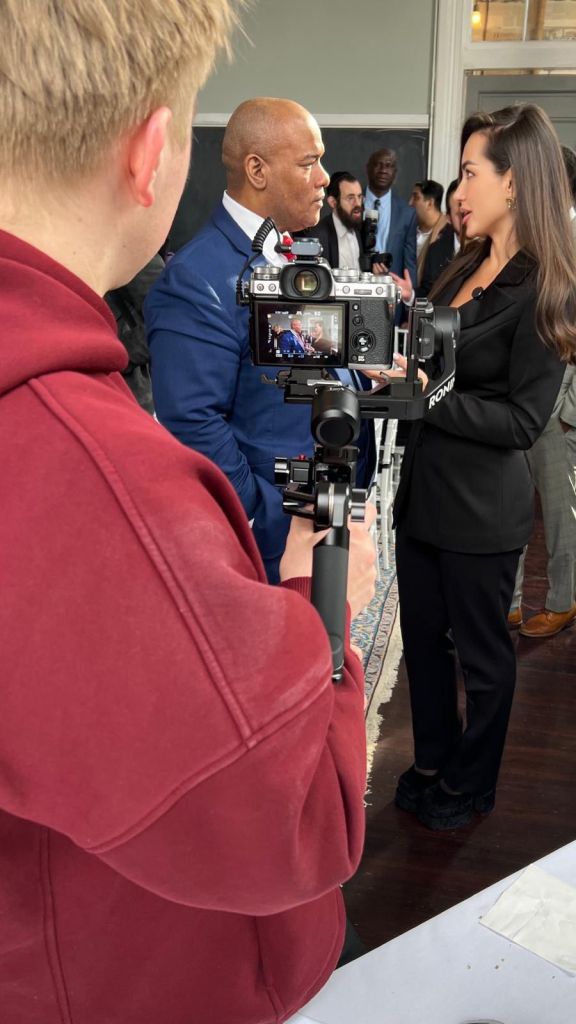
A moment at work, behind the camera lights.
Rebuilding Life After the Invasion
Success on national television brought recognition but not freedom. After years working inside the system, she wanted ownership. “I realized I wanted to be my own boss,” she says. In 2021, she invested her savings, money meant for renovating her apartment, into launching her own YouTube channel. “I thought maybe I lose this money, maybe not. But if I never try, I’ll never know.”
The first episode, an interview with another TV host, went viral. “People already knew me from TV. They trusted me. And I knew how to do interviews. So it worked.”
A year later, she was preparing new collaborations and brand partnerships when the world shifted overnight. “I woke up in Kyiv on February 24, 2022. The war started. All my contracts were canceled. Everything stopped.” She left Kyiv with her son, first for Germany, then for New York in October 2022.
The first months were rough. “It was very difficult for me to live in an awful apartment at first. It was really crazy for the money. I was crying each night, but at the same time I heard the stories of other women working three jobs.” Hearing those stories, she realized she was not alone. Little by little, she found strength again and decided to keep doing what she knew best: telling stories.
Building a Community of Ukrainian Women in New York
In New York, she turned the camera inward. “I had done so many interviews, but suddenly I didn’t have anyone left to interview. So my partner said: tell your own story.” Her channel soon evolved into something more personal and useful. She began producing videos on everyday life in America, how to rent an apartment, find a good school, or cope with loneliness and immigration bureaucracy. “I realized many women were in the same situation, mothers who left Ukraine alone with their children, trying to start new lives.”
To help, she created free yoga sessions in Central Park, just one hour to breathe. Those small gatherings grew into the Ukrainian Women’s Club, which now meets in New York, Chicago, and Miami. “We share information, connections, motivation. Some women have been in America for twenty years, some arrived last month. But we all understand each other.”
Across the United States and Europe, similar circles have appeared, informal, women-led spaces where displaced Ukrainians rebuild support networks from scratch. Her club is part of that wider wave, linking civic energy with personal healing.
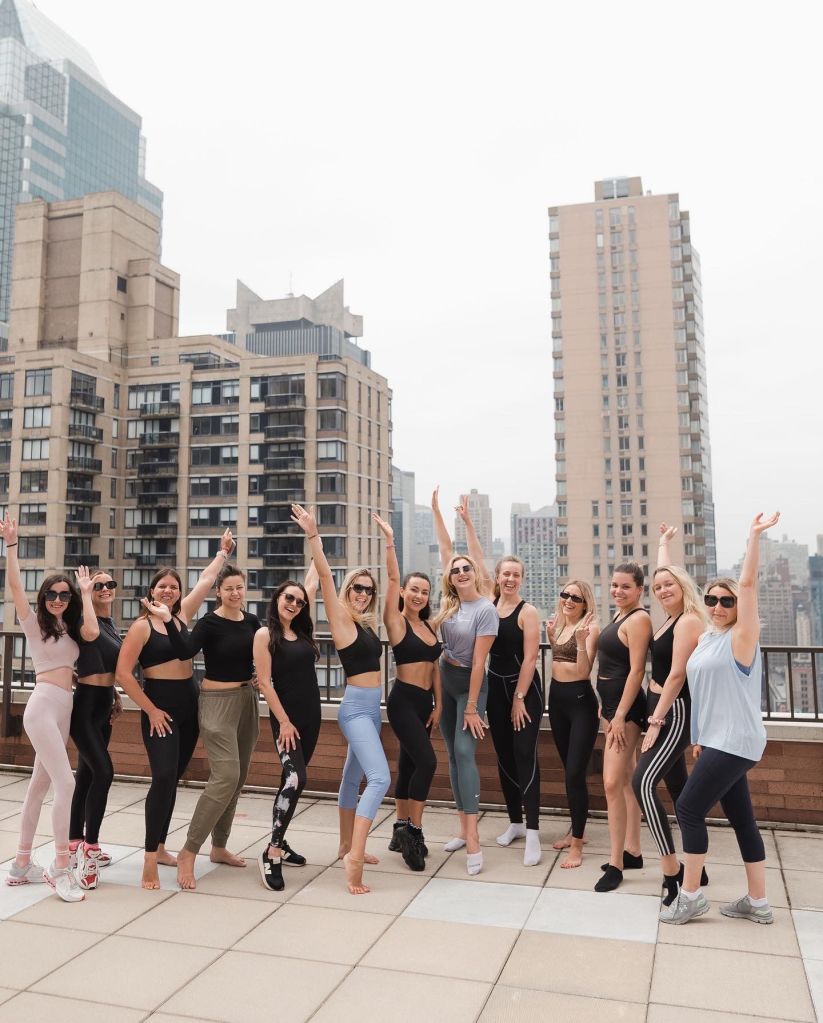
Members of the Ukrainian Women’s Club in New York during a meeting, a community Anna founded to support women starting new lives in the United States.
Supporting other Ukrainian women has become both a mission and a mirror of her own journey. “There’s a unique solidarity among Ukrainian women abroad. Many came with nothing, no language, no savings, and yet they survive, work, study, and raise children.” She pauses. “When you lose your home, community becomes your home.”
Her clubs and online communities offer practical help, how to find legal advice, jobs, housing, but also emotional oxygen. “I saw that if you create a safe space, even just for one evening, women regain energy. They stop feeling invisible.”
She sees these small circles as seeds of something larger, a model for civic life rebuilt from below. “In Ukraine, we often expect help from the state or from men. Here, we learn to rely on ourselves and each other. That’s a quiet revolution.”
At the same time, she refuses to see a divide between Ukrainians who stayed and those who left the country. She believes that war has changed everyone’s lives, no matter where they are. Those who remain in Ukraine defend, rebuild, and endure daily strikes. Those abroad raise awareness, support families, and keep the country’s voice alive in new places. For her, these roles are connected, not opposed, parts of one collective mission to keep Ukraine standing.
Carrying Home Through Culture and Style
Beyond journalism and community, Anna also speaks with pride about Ukrainian fashion designers. “When I talk about Ukraine, I always mention our designers,” she says. “Right now, they are among the most recognized abroad.” Living in the United States, she tries to support them whenever she can. She names BEVZA, The Coat by Katya Silchenko, and Nadiia Dymka, a designer from Lviv whose work she particularly admires. “Nadiia has a very feminine style and a special sense of taste,” she says. “I have many pieces from her, and I always recommend her to my friends. The quality is very high, and the designs feel close to who I am.”
For her, choosing to wear Ukrainian fashion is about belonging. “It’s a way of carrying home with you,” she says. Ukraine remains present in her wardrobe, her voice, and her work. And while she has no immediate plans to return, she carries it everywhere she goes, not as nostalgia, but as identity.
Her son, now growing up in the United States, has changed schools several times since the war began. Stability, she says, is what he needs most. “He often tells me he wants to go back to Ukraine one day,” she confides, “and I tell him that when the time comes, it will be his choice.” For now, she wants him to finish his education in peace, to grow with the kind of possibilities she could only imagine at his age.
Continuing Her Mission
Alongside her community work, she continues to share what she has learned as a journalist. She has published The Strategic Manual to Become an Extraordinary Interviewer, a guide on how to conduct interviews and ask the right questions, grounded in the belief that interviewing is, above all, about human connection. The book is a thoughtful resource for colleagues, students, and aspiring reporters, and a reminder that attentive listening remains at the heart of truthful storytelling.
In New York, Anna has rebuilt more than a career. She has turned her own displacement into a network of strength, linking women, stories, and identities across continents. Her path reflects what Ukraine itself has learned since the war began, that rebuilding starts wherever its people stand.
–
Valentin JEDRASZYK / Echoes from Ukraine
Photos courtesy of @anna_olitskaya
 Echoes from Ukraine
Leave a comment