Tetiana Kupisovska currently works as a Senior Executive Officer at the International Foundation for Electoral Systems in Ukraine. Tanya’s expertise in European affairs, political science, and her leadership during the challenging times of the ongoing war provide invaluable insights into the future of Ukrainian democracy and its integration process within the European Union.
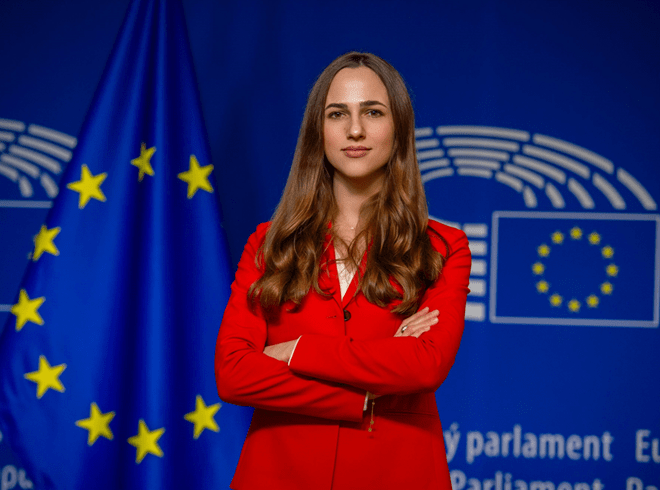
Tanya, let’s start by discussing your educational background. You graduated from the College of Europe in Natolin a few years ago. Is there any particular insight from that time that has stayed with you or shaped your perspective?
Deciding to attend the College of Europe was one of the best decisions of my life. When I applied, I had just finished my master’s degree in France and logically should have started looking for a job. However, I was honored to receive a scholarship from the Polish Government and could not let this opportunity pass.
As a Ukrainian, I felt quite privileged to be part of this school. This intense academic year focused on EU affairs deepened my desire to represent my country within the European family. One particularly memorable moment for me was attending the classes of Timothy Snyder, an American historian specializing in the history of Central and Eastern Europe. His works, which should be more widely promoted, reveal many unknown facts about Ukrainian history and debunk many myths often instrumentalized by Russian propaganda.
You are now working, remotely from Brussels, as a Senior Executive Officer at the International Foundation for Electoral Systems (IFES) in Ukraine. Are you often traveling back to Kyiv?
When the full-scale war started in February 2022, I decided to relocate abroad and work remotely. However, being far away from my country during these difficult times was not easy for me. Hence, a few months later, after gaining a better understanding of the daily reality in various Ukrainian cities, I began returning regularly for work and to visit my family.
I will always remember the first time I went back to Ukraine and the mixed emotions I experienced after being away for so long. On one hand, it felt like a spiritual revival – I wanted to hug the “Ukrzaliznytsia” train I was riding and all its passengers. On the other hand, I felt a heavy sadness seeing how drastically my Kyiv city had changed, becoming emptier and more somber. At times, I would see a cortège of ambulances with military signs carrying our wounded heroes while other cars stopped to let them pass. Such moments highlight the daily difficult reality even more.
The presidential election in your country, which was scheduled for March 2024, had to be postponed due to the ongoing Russian invasion. Considering your expertise in electoral systems, what are your thoughts on the way the war is impacting democratic processes in Ukraine?
There have been significant debates about whether Ukraine’s postponements of its 2023 parliamentary and 2024 presidential elections are democratic decisions. According to our analyses at IFES Ukraine, they are. Ukrainian laws, like those in many Western democracies, recognize that conducting free, fair, and safe elections during a full-scale war is impossible. The Ukrainian Constitution dictates the continuity of presidential and legislative powers until a newly elected president and parliament take office. Secondary legislation, the Martial Law and the Election Code, both stipulate that elections during war should be postponed.
The intention of the Constitution was confirmed by one of the drafters of Ukraine’s 1996 constitution in a recent article by The Economist, who noted that “Zelenskyy continues in power for as long as martial law applies.” It should be noted that there are historical precedents, including European countries that delayed their elections after both World Wars and during COVID-19.
Ukraine should schedule its next elections when the country can ensure the security and democratic integrity of the electoral process. The objective should be to hold elections that are well-managed, free, fair, inclusive, and secure, thereby positively contributing to the nation’s recovery.
From your perspective, what are the critical steps that need to be taken to ensure the resilience and robustness of Ukraine’s democratic institutions post-war?
I would say that it is crucial to continue reforming the country in line with international standards and best practices. Ukraine has already demonstrated its capability to implement high-level reforms. Before the war, institutions such as the European Parliament, Freedom House, and The Economist’s Democracy Index acknowledged the 2019 and 2020 elections as indicators of Ukraine’s democratic strength. These indicators have since declined due to the election postponements and other wartime factors. Despite the war, Ukraine fulfilled the European Commission’s conditions to achieve EU candidate member status and initiated negotiations with the EU. The European Commission’s annual enlargement reports highlight Ukraine’s progress on these conditions throughout the conflict.
To sum up, by prioritizing reforms now, Ukraine can pave the way for a postwar era focused on recovery, resurgence, resilience, modernization, and a renewed commitment to democratic ideals. This is exactly what we, at IFES Ukraine, are working on.
You are deeply committed to strengthening relations between Ukraine and the European Union. Could you share more about your vision for Ukraine’s integration into the European Union and the role you hope to play in that process?
As of last year, over 70% of Ukrainians thought their country should be part of the EU and NATO. In my opinion, no other country has demonstrated a stronger commitment to joining the EU than Ukraine. Historically, this commitment was proven by the Orange Revolution, the Maidan Revolution, and now the war of defense against Russia. Moreover, a country that refused nuclear weapons demonstrates a real commitment to world peace and deserves to be in the European family. The EU should now show firm and clear political support for our European path. Negotiations began in 2023, and this year, we hope to establish a negotiating framework.
I have always been a strong advocate for Ukraine’s European integration. In 2014, during the Maidan Revolution, my friends and I were actively mobilized to support the signing of the Association Agreement with the EU. More recently, I completed a traineeship with the European Parliament Secretariat’s Committee on Foreign Affairs. I had the privilege of observing the announcement of the negotiation openings and the approval of the €50 billion funding package for Ukraine. Being present during this decisive time was important to me, and today, I continue to be based part-time in Brussels, closely following the Ukraine-related agenda.
To finish on a more personal note, how do you balance the demands of your role at IFES Ukraine with the psychological and emotional challenges posed by the war?
Personally, my work helps me get through this difficult period. Acknowledging that what I do for my country is meaningful allows me to be driven forward and not let the emotions distract me from our mission and objectives. Of course, the pain is there, especially seeing what is happening now at the frontline and in many Ukrainian cities. But when you know that the whole team is living through the same emotions and that you can share them, it becomes easier. Interestingly, the time when I am abroad does not save me from experiencing the same emotions as my fellow Ukrainians; sometimes, it is even the opposite—you actually get more stressed than they do.
 Echoes from Ukraine
Leave a comment