Oleksandr Yavtushenko is the Head of the Council for Internally Displaced Persons and Volunteers Council at the Kyiv Regional State Administration, a lawyer, and a human rights advocate. He has agreed to answer some questions regarding his role in supporting Ukrainian displaced persons and his involvement in some communities reconstruction projects.
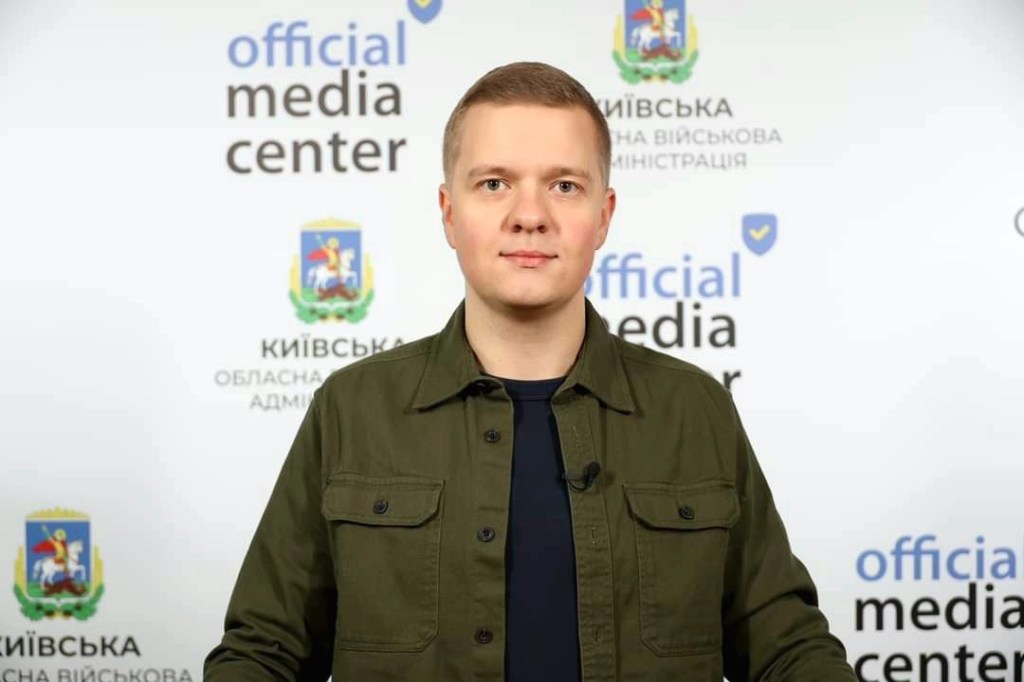
Alex, can you share a bit about your journey before February 2022 ? What were the pivotal moments that shaped your path to where you are today?
My family and I moved to Kyiv in 2014, as our hometown of Luhansk was occupied by pro-Russian separatists. I finished school in Kyiv and, although my parents are doctors, I decided that I wanted to defend people’s rights, so I entered the faculty of law. Already in my first year at university, my friends and I created a social movement whose main activity was the legal and economic education of young people, paying special attention to young people from the occupied territories, like me. I realised how difficult it was for them to adapt after the move and to accept the fact that they would not be able to return home for a long time. I tried my best to create conditions for young people to stay in Ukraine and develop the potential of our country.
As a student, I was able to start a small legal practice in the field of commercial law, and at the same time we provided a lot of free advice to ordinary people on the basis of the university’s legal clinic. Over time, I also headed the legal department of a network of eye clinics across Ukraine and became an assistant to a member of the Ukrainian parliament. At the academic level, I am still deeply involved in the legal regulation of artificial intelligence, which is why I was invited to head the Secretariat of the Public Council of the Ministry of Digital Transformation of Ukraine in 2020.
After 8 years, Russia took off its mask and started a full-scale invasion to Ukraine, the scale of destruction and the problem of internal displacement reached a completely new, unprecedented level. This is where my team and I began our journey as locomotives of the IDP movement.
Can you describe your role and the primary responsibilities as a member of the Internally Displaced Persons (IDP) Council in Kyiv region ?
First of all, it is necessary to explain what an IDP council is. The IDP Council includes representatives of government, public, business and international humanitarian organizations. It is a consultative and advisory body under a regional authority, which helps regional and national authorities to fulfill a number of tasks:
1) Needs assessment and timely identification of the needs of internally displaced persons
2) Development of a legal framework and regional support programs for IDPs.
3) Early resolution of conflict situations with IDPs
4) Control over the proper quality of social services for IDPs
5) Conducting information and awareness campaigns among IDPs.
It is important to note that this work is done on a voluntary basis, we are not paid for it and we do it in our spare time. Directly as the head of the IDP Council I coordinate all directions of this work.
As I am a business person, I have also started a separate programme to support relocated businesses and entrepreneurship potential of IDPs. We teach them how to get a grant to set up their own business and we help them get it absolutely free of charge. We help them to find donors or use state programs for entrepreneurs. The condition for such assistance is the obligation to employ 1-2 migrants. In this way, we contribute not only to the development of the Ukrainian economy but also to the employment of IDPs. We give them the opportunity to feel needed again, to provide their own livelihood, and also to keep them in Ukraine.
In addition, I also chair the Volunteer Council, where we coordinate donors to provide humanitarian aid in the region, ensure public oversight of the transparency of aid distribution, and organise events to support the volunteer movement and address issues that volunteers may face in their work.
What are the most significant challenges internally displaced persons in Ukraine face today?
The main problems of a person after moving to a new territory are, as a rule, finding a place to live and a job. It is important to realise that all IDPs are very different and it is important to understand where they have moved from. For example, migrants from Mariupol usually have technical education and worked at large metallurgical or manufacturing enterprises. Therefore, it is not always possible for them to find a job in their speciality.
Lack of the necessary demand on the labour market causes a problem related to the lack of funds to pay rent, mortgage or buy their own flat in the region where the IDP has moved. These two issues are the most acute today and they are the ones we are trying to solve first of all.
Can you share some key initiatives that the IDP Council you chair has undertaken to address the needs of displaced persons in Kyiv and the broader region?
It is important to note that Kyiv as the capital city has a special administrative status and is not part of the Kyiv Oblast (region). In this regard, our powers do not extend to the city of Kyiv.
As for our key projects. As I mentioned earlier, we are the leaders among all regions in programmes for the development and support of entrepreneurial potential among resettled people. We help them to form a business idea, formalise it, find a donor for its implementation, accompany them, help them with the legal part, taxes and accounting. Such businesses also employ other IDPs as employees.
Another project we are developing with the Greek Catholic Church in Ukraine is the idea of creating an entire settlement for IDPs where they can not only live, but also work (a number of Ukrainian manufacturing and agricultural companies have already expressed a desire to move their production facilities there). This process will also include retraining of people and their psychosocial rehabilitation. The settlement will also include school, kindergarten and medical clinics. We already have land for that project and now we are looking for donors and parters to help us build everything.
Beyond your primary work, you’ve been involved in community projects like building modular shelters for bus stops. Why do you see this as important, and can you describe the impact such projects have on the community, especially in these challenging times?
Our family owns one of the largest networks of eye clinics in Ukraine and, together with our partners, we are also involved in a large construction business, warehouse logistics and personnel outsourcing businesses.
The active phase of the war in Ukraine and constant bomb attacks have created new challenges for public security. Ballistic missiles such as Iskander, Kinjal or Zirkon can reach Ukrainian cities within 3-6 minutes after launch. People on the street have almost nowhere to hide. Large groups of people waiting for public transport at a bus stop are the most vulnerable. The solution is to create large modular shelters where people can safely wait out the alarm.
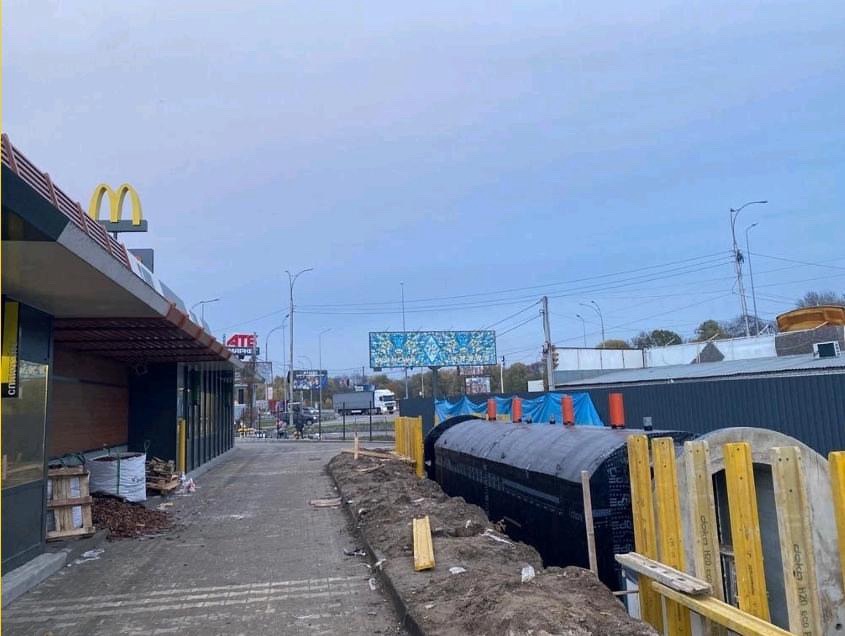
The average cost of such a facility, made of reinforced concrete with an anti-shock shield inside, is about $12,000. Many communities are trying to buy these shelters, but do not have the funds to do so. We have received requests from many communities across Ukraine to help find donors for the manufacture and installation of such modular shelters. There is a need for tens of thousands of these modular shelters throughout Ukraine.
For example, our production and that of our partners can produce 8-10 such shelters per day. This is definitely not enough, but according to our estimates, the total capacity of all such enterprises, which can qualitatively manufacture such shelters, may be close to 70-80 shelters per day. Even at this full capacity, it would take a little more than six months and about $162 million to produce the shelters. we are also negotiating with a number of state-owned enterprises that have the capacity to produce such shelters quickly and efficiently. The only problem is financing. Given our expertise in this area, we would be ready to assist any donors and investors who would like to finance the field of shelter stops in Ukraine.
How can the general public abroad best support the displaced persons you assist and the reconstruction of the country ?
The best help that ordinary people abroad can give is to boycott Russian goods in their countries and to put pressure on their national governments to transfer more arms and ammunition to Ukraine. It is also very important to develop investment relations. Ukraine has great economic potential and we would like to attract investors to create new jobs and add value so that it is a win-win situation. It’s just that humanitarian aid is very good and we really need it, but I think Western business will be more willing to defend Ukraine’s interests and influence their national governments if they have financial interests in our country and not only want to help a European country that has been attacked by Russia, but also want to protect their business in Ukraine.
 Echoes from Ukraine
Leave a comment